Studio Encounter at EKWC
by Xenia Tsompanidou – 07.07.2023
SEA FOUNDATION
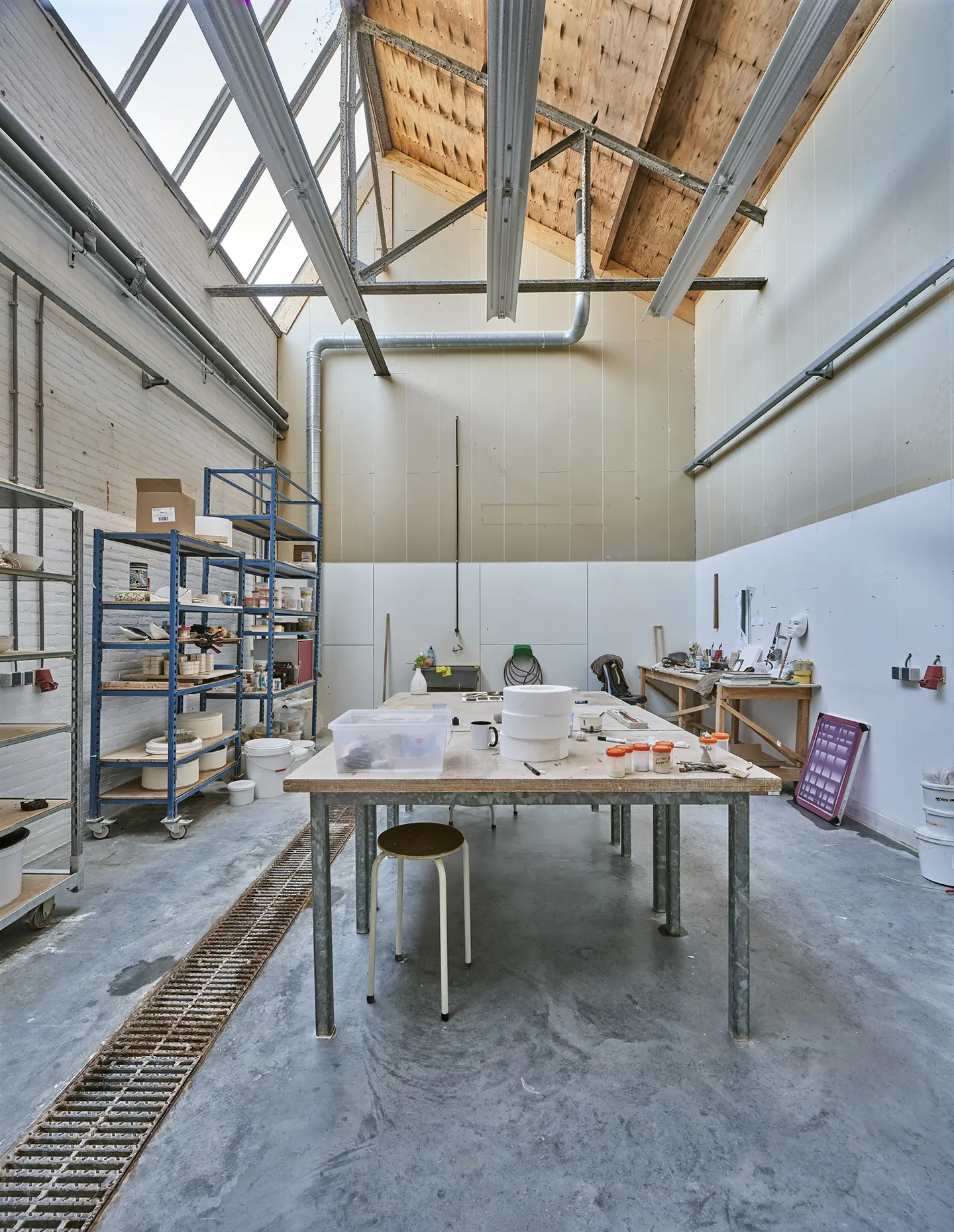
I met with Xavier a month into his three-month residency. He warmly welcomed me the European Ceramic Work Center (EKWC) in Oisterwijk; I was grateful to see the huge workspace for the first time, walking past kilns, glaze rooms and the high-ceiling studios, to get to his own. The studio is spacious, with work tables and walls filled with materials, new ceramic work samples and notes on elaborate ongoing processes. Excited about having the time, space and equipment to dedicate himself into further research on materials and colours, he immediately lets me into the specifics of experimenting in different forms and scales!
“You have to be very rigorous when testing; if you want to find something very interesting you have to test in a lot of different directions„
The artist splits his time in EKWC and his studio diving into books of glaze chemistry, exploring recipes, trying out gloopy forms; sharing his days with fellow residents in a communal way. The following lines are an attempt to convey parts of our engaging time together and offer an inside look into Xavier’s compelling artistic practice.
on matters that matter
Xavier challenges himself in his personal and professional life to make visuals and ceramic artefacts that reflect on human attitude towards the more-than-human and explore the relationship and ambiguity between organic and mineral matter as a means to rethink our link with nature. Asked about the motivation and meaning behind his work, he humbly admits that it is ‘difficult to escape the frame, as it has to do with what is happening with the environment today.’ What he does is composed as a visual critique on the environmental crisis and on human interventions to natural landscapes. The dedication and honesty are reflected in his voice. ‘I know that within the discourse about nature I also have to adjust myself and my own practice.’
shifting landscape narratives
It is impressive to see how his work embodies a sense of urgency but at the same time comes from a place of playful creative experimentation. Merging screen printing and ceramics, the artist explores shapes and placements to build critical landscapes. For his latest projects, Xavier has been combining screen prints and installations. Researching landscape painting of the 16th – 18th century, he was intrigued by how artists of the time painted landscapes indoors, providing only artificial, idealised depictions.
“When they were painting a landscape, they were not going outside. They were sketching, coming back to the studio and organising it, composing it. So, it was all fake! Does it really represent how nature is? Nature is chaos, it’s a mess!„
We dive deeper into this conversation of humans trying to exploit and adjust nature to their own liking. To critique this approach of ‘organising’ nature, he created his own allegorical prints named ‘Ideal Landscapes’. The prints are composed in photoshop merging paintings with photography from now in a patchwork manner to highlight how human intervention affects landscapes. In the first print he shares with me, part of the installation végétation, multiple paintings from the 16th century are combined with the picture of a large mine in the former USSR. The installation’s 3-dimensional structures and images echo each other:
“I use screen printing in a way that blurs the limit of when it stops being a painting and starts to be a photograph, once it is printed. (points at the installation) this was a crescent built for an exhibition in Montreal; the shape of the crescent refers to the shape of the mine. It’s all connected. It’s fossilised nature and here we are talking about mining. Mining shapes the landscape, leaving a huge trace.„
He shows me another one of his Ideal Landscapes, this time featuring a photograph of a landslide in South America.
“I felt very guilty to work with this image; there were victims because of this landslide but it is what is happening right now, I had to show it„
on sustainability
For his project Gathering food after the disaster, Xavier collected his own food waste: chicken bones, orange, avocado, citrus skin, eggshells, tomato brunches. He explains in detail how he dipped them into clay to make sure the shape is not lost, how he fired them at 1000 degrees, burning the organic matter and eventually creating fossilised shapes of his food later to be completed with rot-looking glaze.
But what happens after the exhibition?
Close to the end of our encounter, we reflect on ways such practices can be respectful towards nature as well as sustainable. Making prints is a long process requiring water and energy so he prefers to work with quality over quantity, carefully picking visuals to be printed. For his installations, almost all materials are reused or repurposed. All 850 kilos of rocks used for the À fleur de roche exhibition in Montreal were donated.
“After the exhibition, I put a note online saying I’m giving away pebbles, do you need them for your garden? Just come! And people were very happy!„
At the exhibition space of EKWC, he plans to create the physical landscape’s ground using coffee collected from the common kitchen’s coffee machine. The coffee is beautifully laid on a shelf in his studio to dry. Closing our conversation, we discuss the Rivers and Tides documentary, Andy Goldsworthy, radical ecology art initiatives and ways he would see his practice evolving in the future in a reciprocal relationship with nature:
“If not in a museum or gallery, I would be interested in working outside. In the woods. My process will have to go through weather, through rain, through sun.„

Cérémonie
par Émilie Granjon – 13 janvier au 2 mars 2024
Galerie II
Lorsque le visiteur entre dans la galerie II du CIRCA art actuel, il ressent une impression à la fois familière parce qu’il reconnait les formes qui se présentent à lui et étrange parce qu’il ne comprend pas tout à fait ce qui s’est passé en ce lieu.
Célébrant l’ambiguïté entre l’organique et le minéral, Xavier Orssaud conçoit un ensemble de pièces qui font lieu. Et dans ce lieu, un événement s’est déroulé. Rituel ou cérémonie? Quoi qu’il en soit, ce rite invite au respect des lieux écologiques que nous habitons, à une réflexion sur ce qui s’y est passé précédemment et au renouveau qui adviendra par la suite.
Au milieu d’un sol jonché de cailloux et d’objets épars, des formes élancées ponctuent l’installation. À première vue, il se dégage une esthétique brute de ce qui pourrait ressembler à des restes de troncs d’arbres calcinés, décimés par un incendie dévastateur. En même temps, la couleur terreuse des colonnes évoque un autre univers, celui de la ruine. Certains pourraient aisément évoquer le fait que ces objets font penser à d’éventuels trésors enfouis qui auraient pu être découverts par des archéologues, comme le masque posé au pied d’une colonne. Avec la présence d’un luffa posé sur le sol, l’univers marin n’est pas loin non plus. Les passionnés d’ostréiculture pourraient aussi voir dans les colonnes, les fameux poteaux permettant le foisonnement des huîtres ou autres coquillages. Mais ici, point d’huîtres ni de coquillages!
Si la polysémie de l’œuvre ne passe pas inaperçue, on peut se demander ce qu’ont en commun ces univers ? J’y vois une référence à la fin : celle d’un temps, d’une époque, d’un état qui doit nécessairement advenir pour laisser place au renouveau. Cette fin n’est donc pas morbide; elle est plutôt régénératrice. Elle agit comme un espace liminal, c’est-à-dire un point de bascule, où se mêlent la crainte et le respect. On y trouve quelque chose de sacré que l’artiste dissocie volontairement de son carcan religieux ou mystique. Le côté solennel se dégage de l’ensemble et appelle le cérémoniel.
C’est en écho au cérémoniel que l’artiste reprend les codes de la musique à travers la disposition d’instruments placés ça et là. Des colonnes en céramique, percées d’ouvertures ornées de blanc, évoquent indéniablement les instruments à vent qui agissent comme des indices et des marqueurs du rituel. Ici s’érige une flute, là une trompette. Au sol, une forme saxophonesque confirme la lecture. Dans cette forêt cérémonielle, chaque colonne témoigne de sa similitude et, en même temps, de sa singularité grâce au traitement plastique des formes. Le contraste entre l’aspect brut de la partie centrale, et l’aspect raffiné de la partie supérieure, interpelle. Le brut évoquerait-il l’essence de la matière de toute chose, à l’instar du golem qui, composé d’argile, réfère à l’embryon, ou à l’inachevé? L’extrémité aux formes distinctes, lisses et irisées provenant de moulages de bouchons de carafes décoratifs, caractériserait-elle alors la différence et la singularité? La force du collectif relève de la singularité des voix et met en lumière les interventions humaines sur la nature. C’est dans ce même espace liminal que Xavier Orssaud opère un renversement ou un glissement narratif de la crise environnementale pour jouer sur la porosité des frontières entre l’esthétique d’un désastre annoncé et d’un renouveau espéré.